
Blog
VSF Submariner 126610LN QC Guide: 12 Technical Checks Before Approval

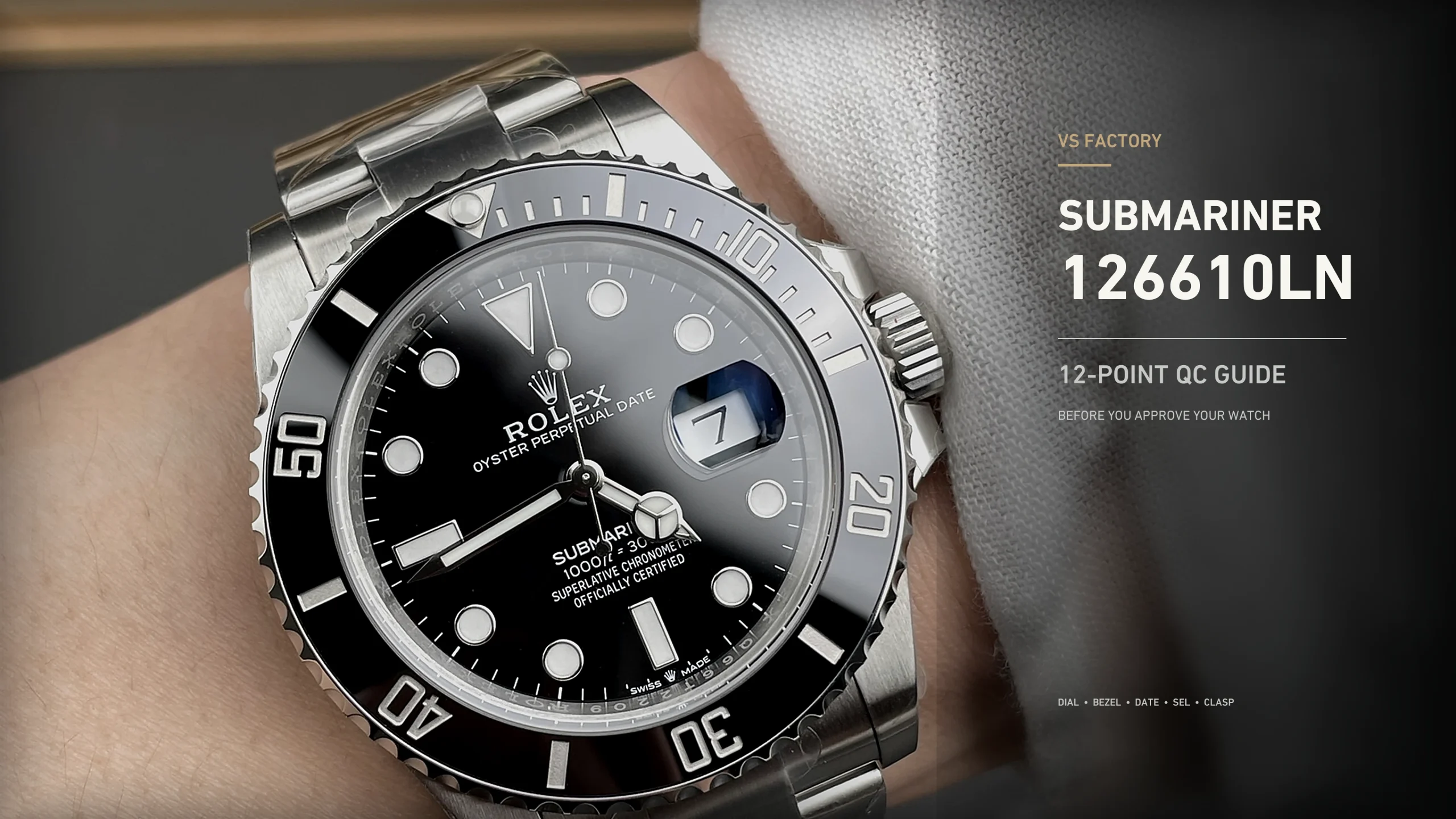
The VSF Submariner 126610LN concentrates its most recognizable details around the bezel, engraved rehaut, Cyclops date, case profile, and Glidelock clasp. These are also the areas where camera tilt, reflections, and protective film can create false alarms. A reliable VSF Submariner QC guide must therefore judge both the watch and the quality of the evidence.
This 12-point VSF Submariner QC checklist moves through those systems component by component. Its six images are reference views captured from the current VSF-10167 catalog on July 26, 2026, not an individual customer’s unit. Use them to request centered photos, continuous functional video, and disclosed test conditions before approval.
📑 Table of Contents
- Confirm the exact unit and correct the camera angle
- Dial, bezel, rehaut, crystal, and date
- Case, crown guards, and solid end links
- Bracelet, clasp, and Glidelock
- Lume consistency
- Movement, timegrapher, and functional tests
- QC decision matrix
1. Confirm the Exact Unit & Correct the Camera Angle
Catalog photography can illustrate the model, but VSF 126610LN QC photos must identify the exact unit. Confirm identity and camera geometry before evaluating alignment.
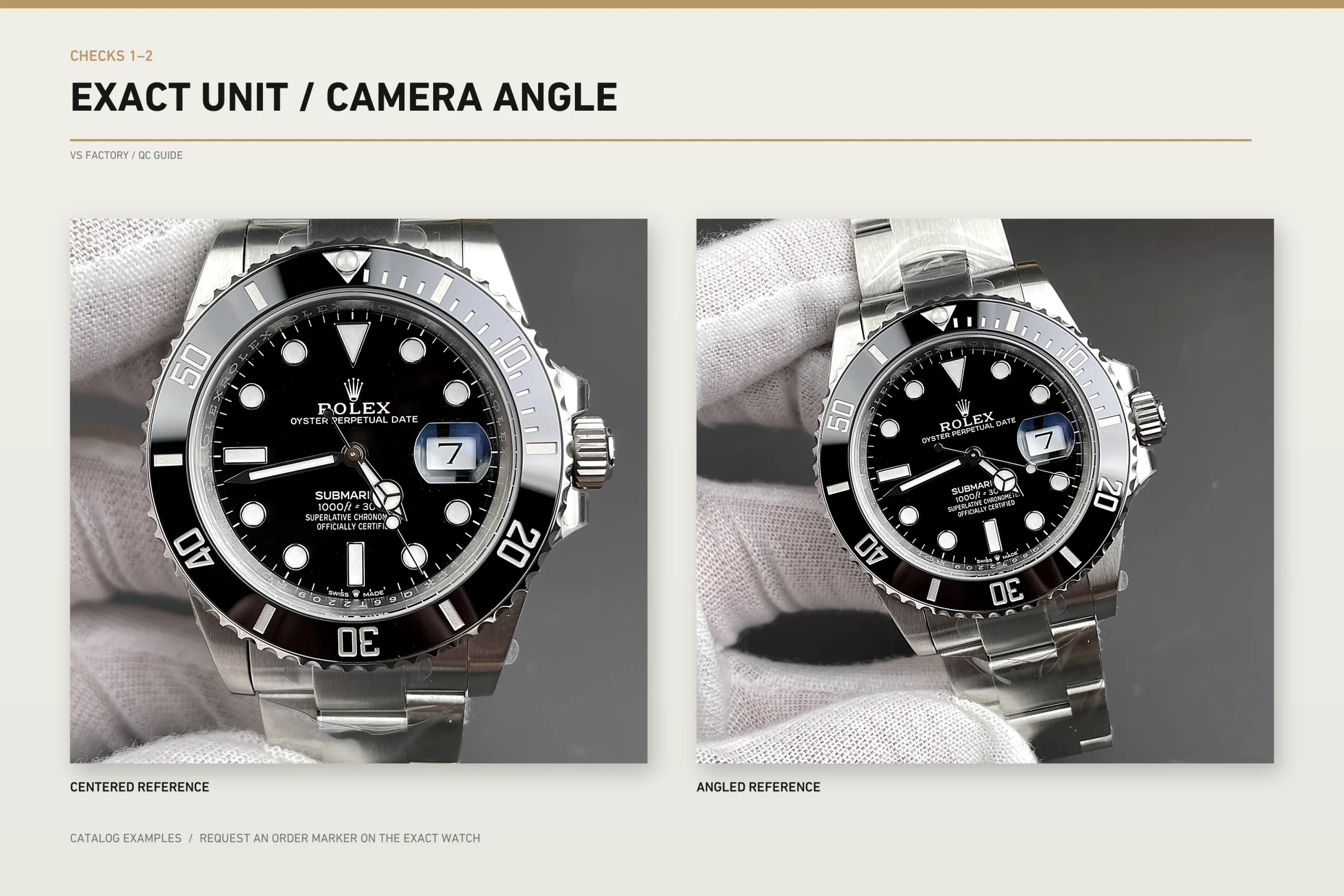
- Check 1 – Exact-unit proof: Ask for an order identifier, date card, or another agreed marker in the frame. The dial, clasp, serial area, and protective-film pattern should remain consistent throughout the set.
- Check 2 – Straight-on geometry: The dial should appear circular, the lugs should look equally sized, and the 12-to-6 axis should be vertical. Use an alignment overlay only after the photograph itself has been straightened.
2. Dial, Bezel, Rehaut, Crystal & Date
Read the dial-facing architecture in layers. A reliable VSF Submariner bezel alignment check separates the bezel, rehaut, dial, Cyclops, and date instead of drawing one conclusion from a tilted frame.
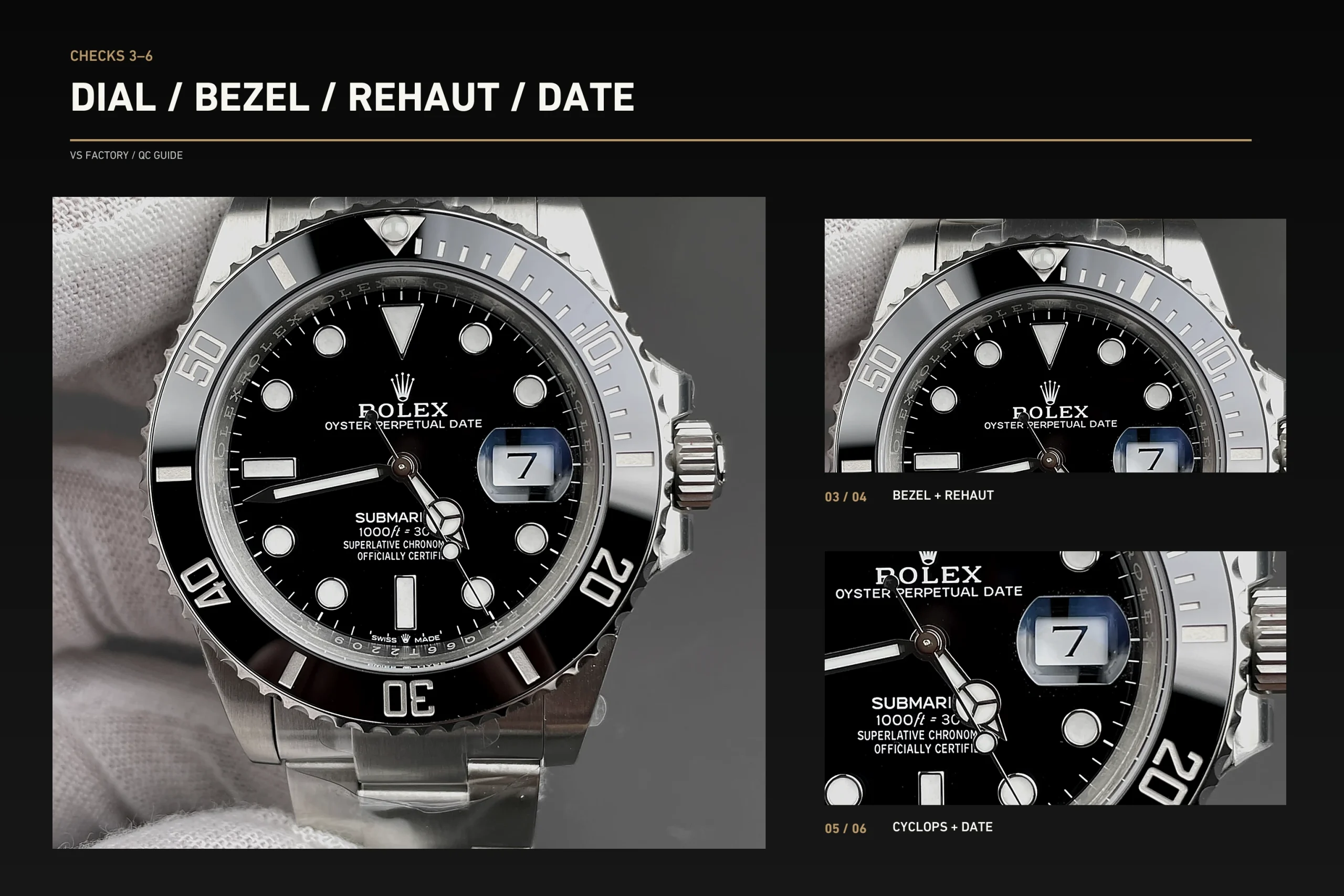
- Check 3 – Bezel and pip: At the neutral position, compare the bezel triangle and luminous pip with the 12 o’clock marker. Request one slow full rotation to observe return-to-center behavior and obvious back-play; tactile click feel remains handler-reported evidence.
- Check 4 – Rehaut: Inspect the 12 and 6 o’clock regions first, then compare both sides at equal distances from center. If a mismatch appears in only one angled image, ask for a level close-up.
- Check 5 – Crystal and Cyclops: Request one centered view and one shallow-angle view. Look for a visibly crooked lens, chips, edge damage, trapped debris, or an obvious optical defect that remains across both angles.
- Check 6 – Date wheel: For VSF 126610LN date wheel QC, ask for at least one single digit and one double digit, such as 8 and 25. Check vertical centering, side spacing, print clarity, and whether any numeral is clipped by the aperture.
3. Case, Crown Guards & Solid End Links
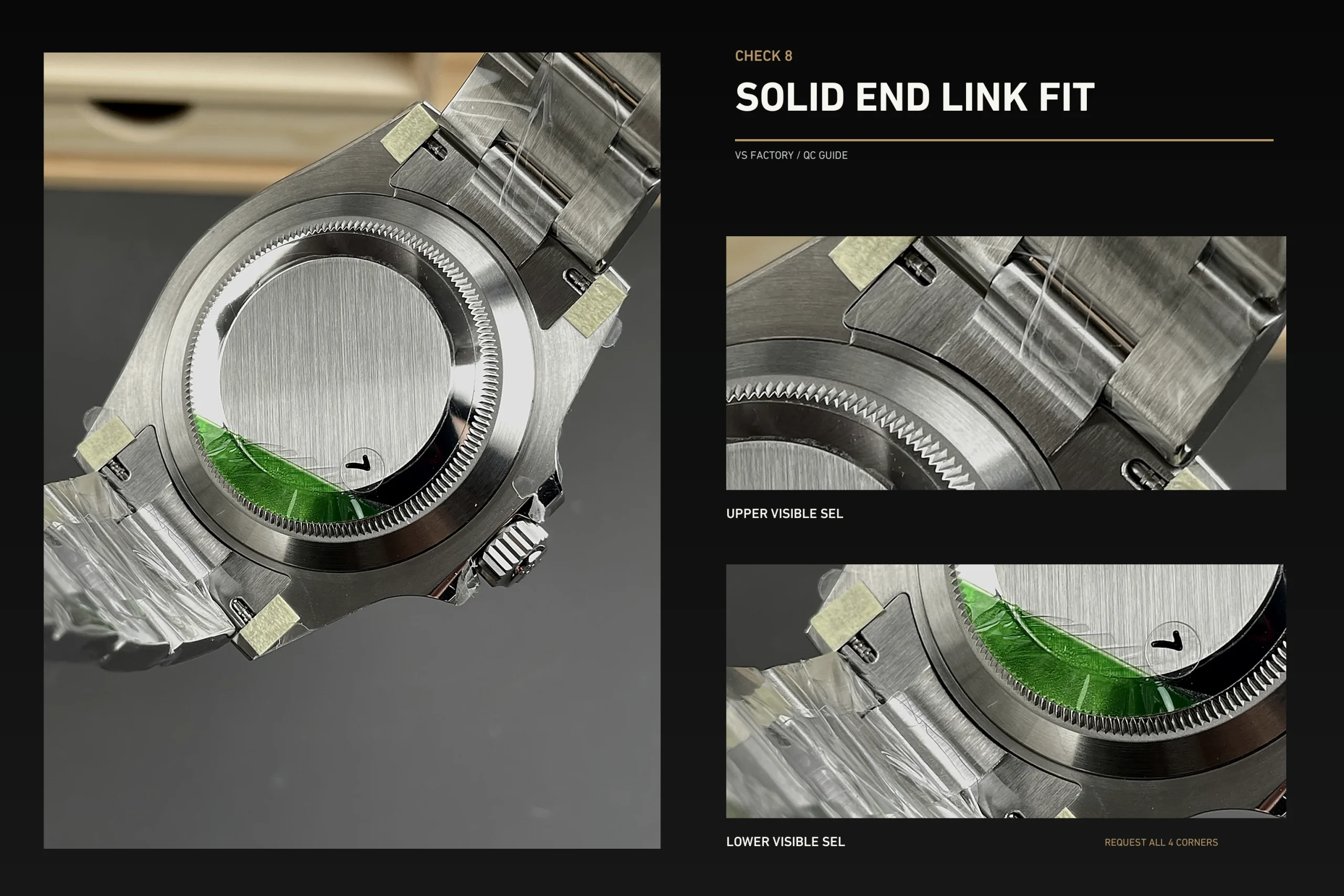
Paired side profiles and a square rear view separate an actual case or SEL fit issue from shadow, reflection, or the edge of protective film.
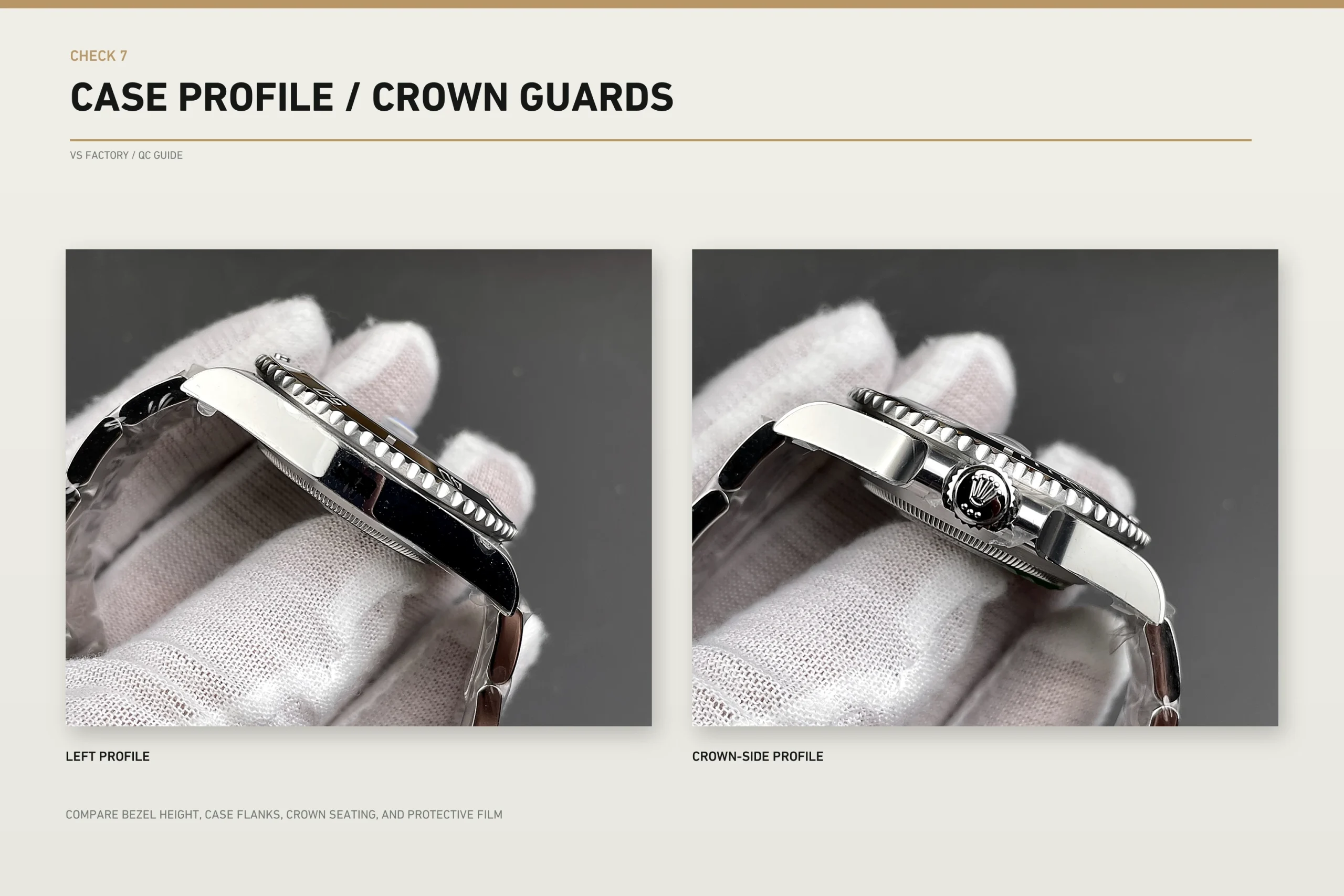
- Check 7 – Case and crown guards: Compare crown-guard shape, crown seating, bezel height, polished flanks, and brushed lug surfaces. Confirm whether a suspicious mark is on the film or the metal.
- Check 8 – Solid end links: Review all four SEL corners under similar lighting. Look for an obvious open gap, a link sitting far above or below the lug, or an uneven fit that changes the bracelet angle.
4. Bracelet, Clasp & Glidelock
Still images show finishing and visible damage, but a credible VSF Submariner Glidelock test needs motion. The clasp, safety lock, and adjustment track should be demonstrated in one continuous sequence.
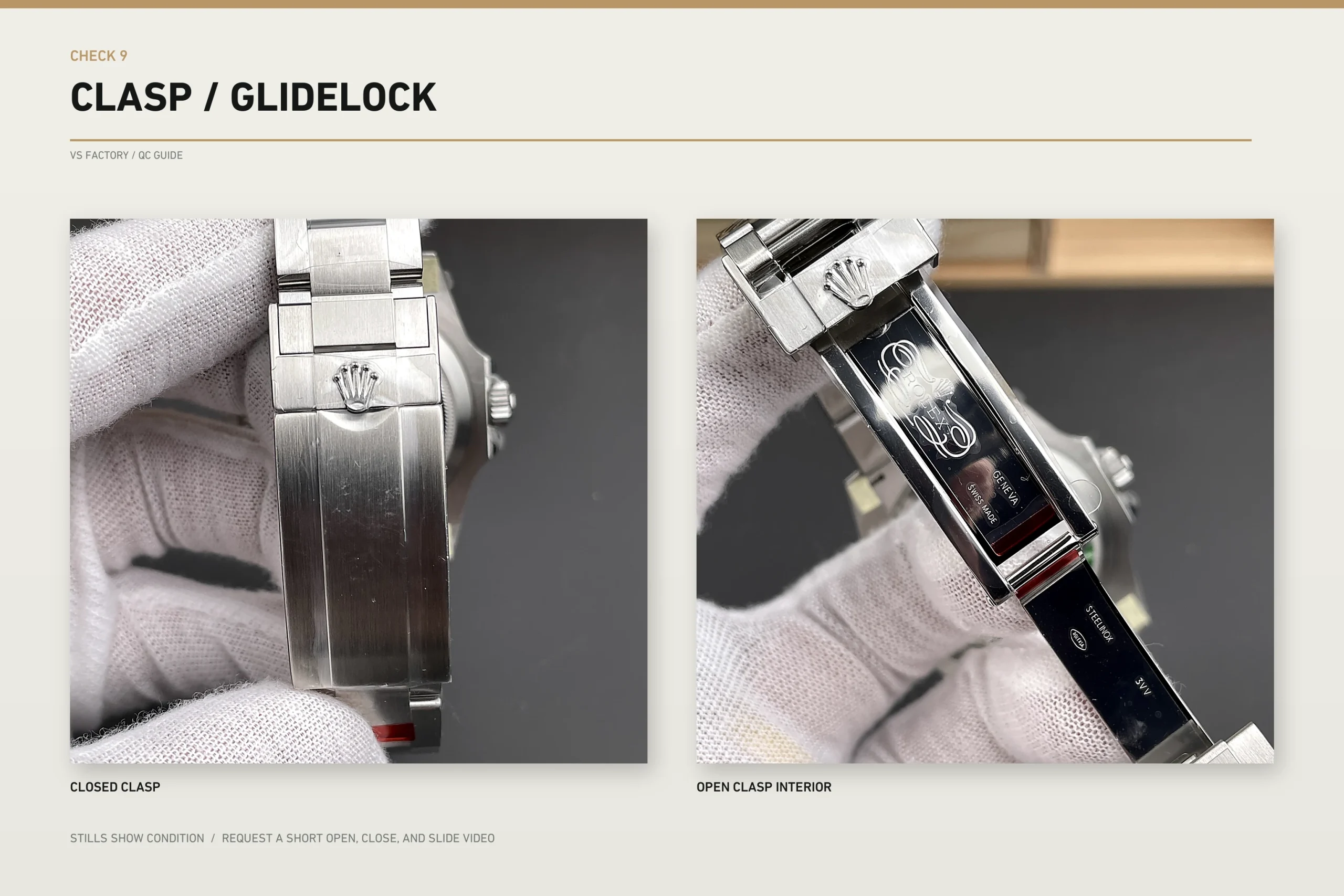
- Check 9 – Bracelet operation: Request a short video of the clasp opening and closing, the safety lock engaging, and the Glidelock moving through several positions. Watch for a link or spring bar that shifts abnormally under light handling.
5. Lume Consistency
Because charging time and exposure can alter the result, VSF 126610LN lume consistency must be judged under matched conditions. Charge the components together and compare color and relative intensity without changing camera settings.
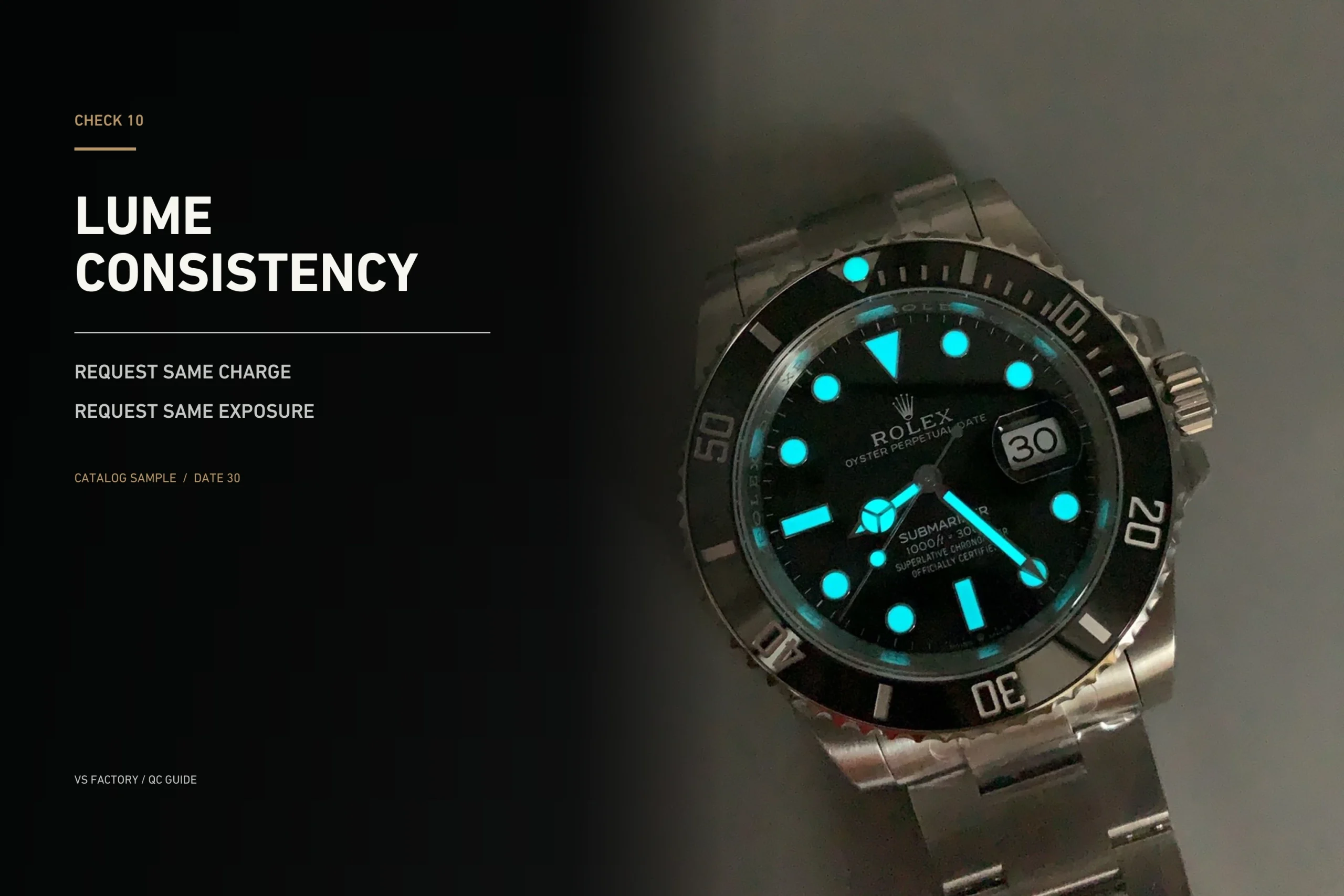
- Check 10 – Relative lume: Ask for the hands, hour plots, and bezel pip to receive the same charge. Compare their color and relative intensity immediately and again after several minutes.
6. Movement, Timegrapher & Functional Tests
Mechanical checks need context. One frozen timegrapher screen does not prove stability, power reserve, movement identity, or water resistance.
- Check 11 – Timegrapher context: Request the test position, state of wind, lift-angle setting, beat rate, and at least 20 seconds of stable video. Read rate, amplitude, and beat error together rather than approving or rejecting from one number.
- Check 12 – Functions and separate tests: The video should show winding, crown positions, time setting, quickset date, the change through midnight, bezel rotation, clasp, and Glidelock. Test power reserve on the exact unit and treat water resistance as unverified until that watch passes an appropriate pressure test.
The live product title uses DD3235, while the description uses VS3235. Treat both as seller labels until the current batch and exact unit are documented.
Rolex lists approximately 70 hours of power reserve and 300 metres of water resistance for the genuine 126610LN. These are reference specifications, not automatic claims for any VSF unit.
7. QC Decision Matrix
The final stage of this VSF 126610LN approval guide is proportional: approve complete evidence, request one targeted follow-up for an ambiguous view, or request replacement when a clear defect persists across corrected views.
| Decision | Use It When |
|---|---|
| Approve | The same unit appears throughout, alignment is acceptable in a level view, functions operate on video, and no clear defect remains unexplained. |
| Ask for more evidence | The concern appears only in a tilted, reflective, low-resolution, or film-covered image, or a required date, SEL corner, setting, or function has not been shown. |
| Request replacement | A clear defect remains across corrected views, the exact unit cannot be verified, a core function fails, or the agreed evidence cannot be provided. |
Final Verdict
A complete VSF 126610LN QC record should establish exact-unit identity, exterior condition, alignment, date presentation, bracelet fit, and basic mechanical operation before shipment. Use the current VSF 126610LN listing to confirm the offered configuration, compare models in the Submariner collection, and review the site’s returns and warranty terms. Approval should follow unit-specific photos and functional video, not catalog assumptions.
Need current-batch proof? Request unit-specific QC photos and a functional video on WhatsApp.
Frequently Asked Questions
What is an acceptable VSF Submariner SEL gap?
There is no reliable universal millimetre limit from a photograph. Look for even seating across all four corners, a persistent open gap across corrected views, or a link sitting far above or below its lug. If one corner looks different, request the same area from another angle before deciding.
How should VSF 126610LN timegrapher readings be judged?
There is no single pass-or-fail number. Read rate, amplitude, and beat error together with the position, state of wind, lift angle, and test duration disclosed. A stable video is more useful than one frozen result.
Why does the current 126610LN listing use both DD3235 and VS3235?
Seller terminology is inconsistent. On the current VSF-10167 page, the title says DD3235 while the description says VS3235. Do not infer movement identity from the label alone. Ask which movement is in the current batch and request evidence for the exact unit.
Reference Notes
- Rolex Submariner Date 126610LN – official genuine-watch model and feature baseline.
- Rolex Newsroom: Submariner – official genuine collection specifications.
- RepTimeQC first QC guide – community visual inspection workflow.
- RWI timegrapher guide – community explanation of rate, amplitude, beat error, and lift angle.